
The Status Architecture: Why Complexity Is the Currency of Technical Prestige and Who Pays the Bill
The Architect Gets the Credit. The On-Call Engineer Gets the 2 A.M. Page.

Two performance reviews are happening in the same engineering organization on the same day.
The first: a principal engineer who spent eighteen months migrating a working three-service application to a fourteen-service microservices architecture with a Kafka event backbone, a dedicated configuration service, and a service mesh. The system is harder to debug than it was before. Deployment complexity has tripled. Two engineers left the team because the operational overhead consumed every sprint. The principal engineer receives a strong review and a promotion to staff engineer. The review cites technical depth and architectural vision.
The second: a senior engineer who proposed and built an ASP.NET Core Razor Pages application with htmx and a single PostgreSQL database that replaced a legacy system the organization had been trying to modernize for four years. The migration took three months. The new system has had zero production incidents. New engineers reach full productivity within two weeks. The senior engineer receives a satisfactory review and no promotion. The feedback is direct: “We’d like to see you take on more technically ambitious work.”
Neither manager made an obviously wrong decision. Both responded to the signals their organization trained them to read. The problem is that the organization trained them to read the wrong signals.
This is not a story about individual vanity or personal ambition. It is a story about a market structure. Software architecture has a status economy, and that economy assigns prestige to complexity the way a luxury goods market assigns prestige to expensive watches. The expense is the point. And the people paying the expense are not the ones wearing the watch.
The Veblen Economy of Technology
Thorstein Veblen published “The Theory of the Leisure Class” in 1899. He observed that wealthy societies create goods whose demand increases as their price rises. People buy these goods not for utility but to display the capacity to spend. He called this conspicuous consumption. The value of the display comes from its cost. A cheaper alternative that performs the same function misses the point, because the function is the display itself.
Technology choices in software architecture follow Veblen’s logic with unsettling precision. Microservices architectures are more expensive to build, operate, and maintain than a well-structured monolith for the majority of use cases. Kubernetes requires operational investment that adds no direct product value below a certain scale threshold. Event sourcing adds implementation complexity that few CRUD applications can justify. The expense is precisely what makes these choices valuable as status signals. A Razor Pages application is cheap to produce. Its low cost is legible as low ambition. The expensive choice announces that the architect is operating at a level where such expenditures are appropriate.
Robert Frank’s work on positional goods extends Veblen’s thinking. A positional good’s value comes not from its absolute qualities but from its position in a ranking relative to substitutes. The value of displaying Kubernetes experience is not absolute. It is relative to displaying PostgreSQL experience. As long as Kubernetes ranks higher than PostgreSQL in the professional status hierarchy, the push to adopt Kubernetes persists regardless of operational fit.
This is the mechanism that makes the signaling arms race in architecture so durable. When distributed systems expertise becomes table stakes, event sourcing becomes the differentiator. When event sourcing becomes table stakes, CQRS and saga patterns become the differentiator. The frontier keeps moving. Each generation of architects must adopt the next complexity tier to maintain positional standing. The cost compounds. The status value of any individual technology decays as adoption spreads.
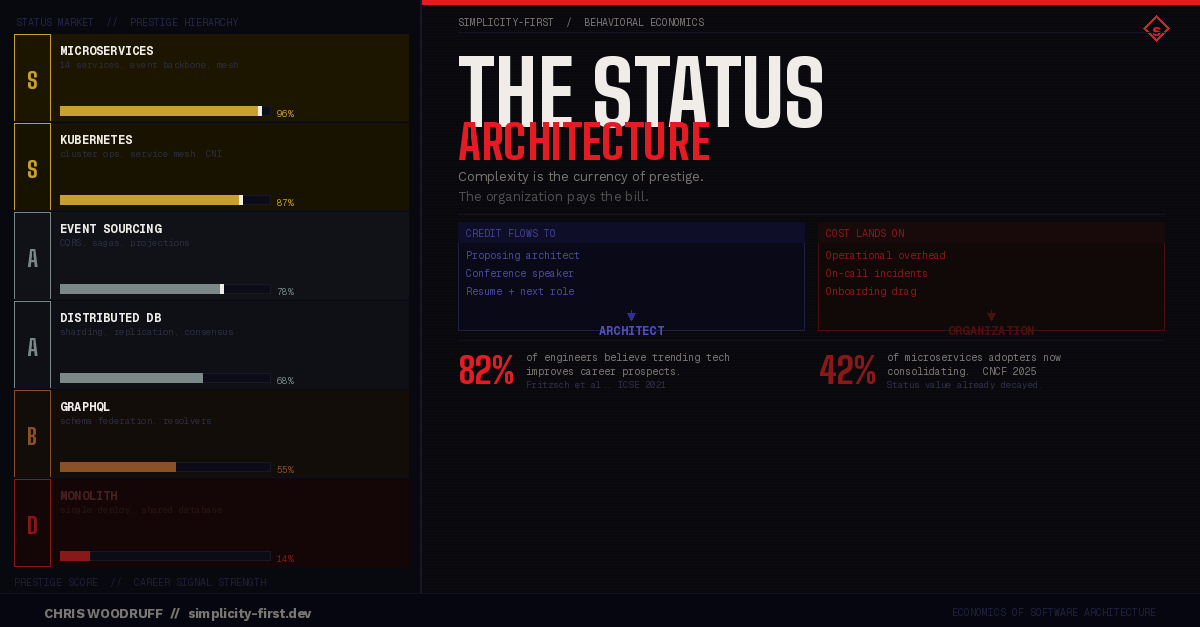
The CNCF 2025 survey found that 42% of organizations that adopted microservices are now consolidating them. The consolidation is happening now, years after the status value of microservices adoption peaked and began to decay. The organizations paid for the adoption. They are paying again for the consolidation. The architects who drove the adoption have largely moved on.
The Conference Market: Where Status Gets Made
Conference programs are not neutral curations of engineering knowledge. They are status markets with explicit selection criteria.
Submit a talk titled “How We Migrated 200 Services to Kubernetes” alongside a talk titled “How We Kept Our Monolith and Tripled Throughput.” Track acceptance rates. The distributed systems talk gets selected in most programs, not because it conveys more useful engineering knowledge, but because it aligns with the status hierarchy that conference organizers, sponsors, and attendees have built together.
Conference organizers are not villains in this story. They respond to what their audience rewards with attention and engagement. The problem is that the selection process is a feedback loop. Complexity gets selected, amplified, and normalized as the standard of serious engineering work. Simplicity gets filtered out. Engineers who attend these conferences carry home a calibrated sense of what sophisticated architecture looks like. What they saw selected on stage becomes their reference point.
Joel Spolsky named this pattern in 2001 when he coined the term “architecture astronaut”: practitioners who operate at such high levels of abstraction that they lose connection to the systems they are supposedly designing. Architecture astronauts thrive in the conference market. The talk about a distributed systems library nobody has used yet outranks the talk about reliable patterns that ship product. The blog post about an event-driven saga implementation generates more engagement than the post about a well-structured repository layer.
At scale, this creates a generation of senior engineers whose professional identity is built around technical sophistication rather than operational outcomes. They write influential posts. They give well-attended conference talks. They publish open source libraries. And when they join an organization as a principal engineer or head of architecture, they design systems that match their public identity, not systems that match the organization’s needs.
The Junior Engineer Penalty
The status economy produces a specific harm for engineers early in their careers: the simplicity penalty.
A junior engineer who proposes and builds a working simple system receives credit for the output. A junior engineer who proposes and builds a complex system receives credit for the output and the demonstrated technical ambition. Complexity signals aspiration. Simplicity signals the absence of it.
This creates a rational learning response that compounds over a career. Engineers learn early that proposing simple solutions carries professional risk. The simple solution might work perfectly and still be perceived as insufficient effort. The complex solution might fail operationally and still be perceived as technically admirable. The lesson the engineer takes from this is the wrong one: proposal quality gets measured by technical ambition, not by operational fitness.
Fritzsch and colleagues documented this in their 2021 ICSE study of Resume-Driven Development, surveying 591 software professionals. Eighty-two percent believe that experience with trending technologies makes them more attractive to future employers. This belief is not formed in a vacuum. It forms through performance reviews, promotion decisions, conference selections, and job postings, every evaluation signal the market sends. The belief is rational given the market the engineers inhabit. The market is the problem.
Most engineering career ladders reward technical scope. Principal engineer requires demonstrated impact across multiple systems. Staff engineer requires influence on architectural direction. Distinguished engineer requires industry recognition. Each criterion, as commonly applied, rewards the complexity of the contribution rather than the simplicity of the outcome.
The engineer who consolidates fourteen services into four, reducing operational overhead, onboarding time, and incident frequency, has made the organization’s system genuinely simpler. The career ladder does not know how to value this contribution. The engineer who adds a service mesh to the existing fourteen services has increased complexity. The ladder reads this as expanded technical scope and rewards it accordingly.
The career ladder rewards the scope of the technical contribution. It has no mechanism to reward the courage of the technical restraint.
Social Comparison and the Reference Class Problem
Leon Festinger’s 1954 social comparison theory established that humans evaluate their abilities by comparing themselves to peers. In the absence of objective standards, peer comparison fills the gap. Software architecture has limited objective standards for right-sized complexity. The available comparison is peer practice: what are architects at comparable organizations building?
The answer to that question, in the current market, is almost always more than you. The peer comparison signal is biased toward complexity because the complex architectures get written about, discussed, and amplified. The simple, operational architectures at organizations like Basecamp or Stack Overflow are acknowledged as outliers. The FAANG-influenced distributed systems architectures are treated as the standard, even for organizations whose scale and requirements bear no resemblance to FAANG’s.
When an architect asks whether their architecture is appropriately sophisticated, the reference class they use is almost always wrong. They compare their fifteen-person startup to Netflix, not to other fifteen-person startups. Netflix’s architecture is visible, documented, and prestigious. The architecture of a comparable startup is invisible. So the architect concludes that their Kubernetes cluster is not just appropriate but obviously necessary, because it matches what serious engineering organizations do.
Adrian Cockcroft, former Netflix Cloud Architect, has stated publicly that Netflix’s architecture is not appropriate for most organizations and should not be treated as a default model. The statement has had negligible effect on adoption patterns. The reference class problem is immune to individual corrections because it is structural.
Stack Overflow serves hundreds of millions of monthly active users with nine on-premises servers and no microservices architecture. The case study exists, is thoroughly documented, and is consistently treated as the exception. Organizations read it as proof that Stack Overflow is an unusual company, not as a reference class for their own architectural decisions.
How Organizations Amplify the Problem
Individual status calculations get amplified by organizational structures that encode the same preferences.
Hiring criteria favor candidates with complex technology experience. Job advertisements list Kubernetes, event sourcing, and distributed systems as requirements for roles that will never require them. Promotion panels assess candidates by the sophistication of their architectural contributions. Architecture reviews reward proposals that demonstrate technical depth.
Each structure is individually defensible. Hiring for proven technology experience reduces training time. Rewarding sophisticated contributions pushes teams to learn. Architecture reviews that probe technical depth catch underspecified proposals. But when all four structures operate at the same time, the aggregate effect is an organization that has built a status economy rewarding complexity at every layer, with no counterweight measuring operational outcomes.
Vendors are active participants in this economy. Cloud certification programs train engineers in vendor-specific complexity. Vendor-sponsored conference tracks feature vendor-native architectural patterns. Vendor tooling defaults to configurations appropriate for large-scale deployments, presenting multi-service distributed architectures as the obvious starting point rather than the endpoint of a scaling journey.
Vendors benefit from complexity. A simpler architecture uses fewer managed services. A complex architecture is a procurement dependency. The vendor’s interest in promoting complexity aligns precisely with the architect’s interest in demonstrating sophistication. The organization’s interest in operational simplicity has no equivalent advocate in this arrangement.
AWS’s well-architected structure reference architecture for a basic web application includes eleven distinct managed services. That structure’s definition of “well-architected” encodes vendor complexity as the standard. An organization that uses that structure as its primary architectural reference will produce systems that are well-architected by the vendor’s standard and potentially over-engineered by any operational standard.
Rebuilding the Status System
The mechanism that must change is not the individual architect’s values. It is the measurement and recognition systems that assign status.
Telling architects to choose simpler solutions without changing the evaluation system produces two outcomes: architects who publicly agree and privately continue existing behavior, and architects who attempt simplicity and suffer the career consequences the status economy produces. The corrective mechanism must operate at the level of the system, not the level of the individual.
Rewrite the career ladder criteria. The move from senior to staff engineer should require demonstrated impact on operational simplicity, not just demonstrated technical scope. Add an explicit criterion: demonstrated cases where the architect simplified a complex system in a way that measurably improved team velocity, incident rate, or onboarding time. Make simplification a recognized career achievement. Engineers target what the ladder measures. Change what the ladder measures.
Change what architecture reviews celebrate. The current review cycle asks whether a proposal is technically sophisticated enough. The reformed review cycle asks what the operational cost of the architecture will be at eighteen months, what the Total Cost of Architecture is, what the simplest viable alternative looks like, and why it was rejected. The review should assign recognition for rigorous simplicity analysis. Engineers design proposals to earn recognition from the review process. Change what earns the recognition.
Build an internal case study culture. Organizations that resist complexity accumulation document their simple solutions as engineering achievements. The post about the Razor Pages application that replaced four years of failed microservices migrations should carry the same internal status as the post about the Kubernetes migration. Most organizations do not write the first post because they have no mechanism to assign status to operational simplicity. Building that mechanism requires deliberate editorial effort from engineering leadership.
Apply the Three Filters as a public standard. The 2 AM Test, the Half-Rule, and Primary Path First are not just decision tools. Applied publicly and consistently, they become a counter-status system. When the organization’s most senior architects apply these filters to their own proposals, and when the application is recognized as rigorous rather than limiting, the filters carry prestige. The engineer who builds the half-version and ships it becomes the model for sophisticated restraint. This only works if leadership applies the filters to their own decisions first and records doing so.
What the Individual Architect Can Do
The status economy will not change because one essay named it. Architects who propose simple solutions in organizations that reward complexity are taking a real career risk. This section does not pretend otherwise.
Reframe the simplification as the hard problem. The conference talk “How We Kept Our Monolith and Tripled Throughput” has a harder path to selection than the distributed systems migration talk. The talk “Why We Chose to Reject Microservices After a Six-Month Evaluation” has a better chance. The framing signals that you considered the complex option seriously and made a sophisticated judgment to reject it. The judgment carries the status. Lead with the judgment.
Quantify the outcome in terms that carry organizational status. “$180,000 in annual operational savings” registers with the people who control promotion decisions. “Zero production incidents in eighteen months” registers with the CTO who has been on the receiving end of 2 a.m. calls. Operational outcomes translated into financial and reliability terms convert simplicity into a language the existing status system recognizes.
Build a public record of deliberate restraint. Writing about why you chose not to adopt a technology is a category of engineering content that is underproduced and disproportionately visible when it appears. The engineer who writes “We evaluated Kubernetes for six months and here is why we chose not to adopt it” has produced something rare and credible. Rarity and credibility carry status.
The Amazon Prime Video team published exactly this kind of post in 2023. They documented a migration from microservices to a monolith that reduced costs by 90%. The post framed the simplification as a sophisticated engineering achievement rather than an admission of earlier error. The 90% cost reduction was the status marker. The monolith was the mechanism. The framing separated the two, and the post reached an enormous audience. Engineers in the replies said it gave them permission to make the same argument at their own organizations.
Permission is what the status economy withholds from simplicity. The way to grant it is to make the argument publicly and to attach numbers the market cannot ignore.
The Architecture Tax, Revisited
The first essay in this series calculated the Architecture Tax as the recurring cost an organization pays for complexity that was chosen rather than required. The status economy is the mechanism that drives the choice. Organizations pay the Tax year after year not because the complexity was ever technically necessary, but because the evaluation systems governing hiring, promotion, and architectural review made complexity the rational career choice at every decision point.
The costs land on the organization: the operational overhead, the onboarding burden, the incident frequency, the engineering time spent on coordination rather than creation. The status accrues to the individuals who built the complex system and have long since moved on.
The bill goes to the organization.
The credit goes to the architect.
Fix the credit system, and the bill starts to shrink.