
The Abstraction Budget
Why Every Interface, Generic, and Pattern in Your Codebase Has a Price You Have Not Paid Yet

The pull request lands in code review on a Wednesday afternoon. A junior engineer has integrated a new payment processor. The work is clean. The tests pass. The senior engineer reviewing the PR makes one request.
“Extract a PaymentProcessor interface. Pull the Stripe code into a single implementation. Make the new processor a second implementation. Add a factory to choose between them.”
The junior engineer pushes back. “We have two processors. We are not planning to add a third. Why are we doing this?”
The senior engineer gives the standard answer. The one every engineer has heard, given, and accepted.
“What if we need to swap them out later? What if we add a third one? We want this to be flexible.”
The PR is updated. The interface is extracted. The factory is added. Both engineers feel they have done good work. The senior engineer feels they protected the codebase. The junior engineer feels they learned something.
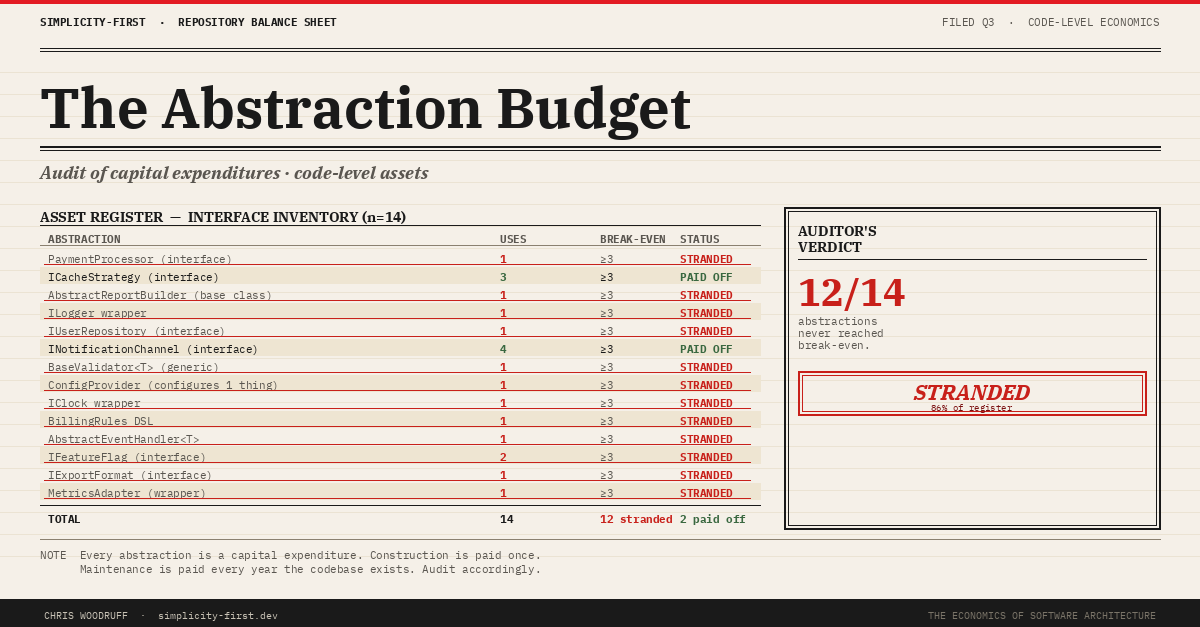
Three years later, the codebase has fourteen interfaces just like this one. Two of them have a second implementation. Twelve of them have one implementation, an interface declaration, and a small amount of factory code that exists to choose between the only option.
The fourteen interfaces are not making the codebase more flexible. They are making it slower to navigate, harder to debug, and more expensive to onboard. Each interface added 60 to 200 lines of code, a layer of indirection in the call stack, and a cognitive checkpoint for every engineer who has to trace through the code afterward. The investment was made fourteen times. The return arrived twice.
Nobody has computed the comparison.
Abstraction as Capital Expenditure
In corporate finance, a capital expenditure is money spent now to acquire an asset that will generate value over future periods. Buying a piece of equipment is a CapEx decision. Building a factory is a CapEx decision. The expenditure happens once. The value appears over the years. The decision is justified by whether the future value exceeds the upfront cost, discounted for time and risk.
Every abstraction in a codebase is a capital expenditure. The cost is paid up front in engineer time spent designing the abstraction, in the immediate complexity added to the codebase, and in the cognitive overhead imposed on every engineer who reads the code afterward. The value is paid out over time as savings that accumulate each time the abstraction is reused, extended, or swapped.
The economic decision is direct. Will the future value exceed the upfront cost? Most abstractions are added without anyone asking this question. The engineer adding the abstraction assumes future value will be high. The engineer reading the code six months later has no way to verify the assumption. The future value is hypothetical. The upfront cost is real.
The result is fourteen interfaces with twelve stranded assets. The cost-benefit calculation is never run. The benefits are imagined. The costs are paid.
The Break-Even Point
Every abstraction has a break-even point. Most never reach it.
For an abstraction to pay for itself, the future value it generates must exceed the cost of building and maintaining it. The future value is measurable. Each use of the abstraction saves some amount of code, time, or cognitive load compared to the inline alternative. The total saving over the abstraction’s lifetime is the future value.
The calculation has four inputs. The cost of construction: engineer time to design, implement, and document the abstraction, plus the immediate complexity added to the codebase. The cost of maintenance: engineer time spent reading, understanding, debugging, and updating the abstraction each year throughout its lifetime in the codebase. The value per use: the savings compared to writing the inline version each time. The number of uses required: construction cost plus maintenance cost divided by value per use.
For most code-level abstractions, the break-even point is somewhere between three and ten uses, depending on the abstraction's size and the maintenance burden it imposes. A PaymentProcessor interface with one implementation needs to grow to at least three implementations before the construction and ongoing maintenance cost is recovered. An abstract base class with one subclass needs at least three subclasses. A wrapper around a third-party library needs at least three contexts where the wrapper meaningfully simplifies the underlying API.
Industry data on how abstractions actually pay off is poor. Organizations do not measure this. The qualitative pattern is consistent across every codebase in production for more than three years: most abstractions are added in anticipation of three or more uses and reach a final state of one or two. The break-even is never crossed. The investment loses money for the organization every year the codebase exists.
The Stranded Asset Problem
In corporate finance, a stranded asset is a capital investment that has lost economic value before its expected useful life ends. The factory was built for a product line that did not catch on. The equipment was purchased for a canceled contract. The asset exists on the balance sheet, but its value is below the cost of maintaining it. Stranded assets are pure loss after the moment they become stranded.
Code abstractions become stranded under three conditions. The use case that would have generated the second and third uses never materialized. The technology or business context changes, and the abstraction no longer fits the new reality. The team that built the abstraction moves on, and the successors do not understand it well enough to use it correctly, so they write around it instead.
Most stranded code abstractions are stranded for the first reason. The future use that justified the abstraction did not arrive. The team built a hypothesis that turned out to be wrong. The hypothesis was reasonable when the abstraction was built. The world did not cooperate.
The economic problem is that the stranded asset does not disappear when it becomes stranded. The interface is still in the codebase. The factory code still runs. The cognitive checkpoint still imposes itself on every engineer who follows the call stack. The maintenance cost still accrues. The asset is a dead weight on the codebase that nobody has the authority to remove, because removing it would require explaining to the rest of the team why the abstraction was added in the first place.
The stranded asset survives because removing it is uncomfortable. The cost survives because the asset survives.
Why the Industry Trains Engineers to Add Abstractions
Three structural forces push engineers toward over-abstraction. Each one is rational at the individual level. The combination produces the stranded-asset accumulation.
The status signal. As The Status Architecture essay argued, complex code earns career capital. An engineer who proposes a sophisticated abstraction looks senior. An engineer who proposes inline code looks junior. The abstraction is the resume keyword. The inline code is the work that does not get talked about at conferences. Engineers add abstractions because that’s what senior engineering looks like.
The defensive instinct. Engineers have been criticized in code review for not abstracting enough. The criticism produces a learned defensive response: when in doubt, abstract. The cost of being criticized for over-abstraction is small. The criticism is rare because it requires the reviewer to make a harder argument. The cost of being criticized for under-abstraction is higher. The criticism is common because it is the easier argument to make. The asymmetry produces a systematic bias toward over-abstraction.
The teaching tradition. The canonical software engineering textbooks, from the Gang of Four Design Patterns onward, are catalogs of abstraction techniques. They teach engineers what abstractions exist and how to apply them. They rarely teach engineers when to leave out the abstraction. The omission is structural. A chapter titled “Why You Probably Should Not Add an Interface Here” does not appear in most books, because the books were written by engineers who built sophisticated systems and got rewarded for them.
Three forces. One direction. The result is a profession trained to add abstractions and not trained to evaluate whether the abstractions paid off.
Five Anti-Patterns That Concentrate Stranded Assets
Every codebase in production for more than three years carries some version of these five patterns. Each one is a stranded asset waiting to be named.
The Premature Interface
An interface is extracted before there is a second implementation. The interface declares a contract that only one class fulfills. The factory code chooses between the only option. The abstraction is pure overhead until a second implementation arrives, which, in the median case, never happens. The interface is sitting in the repository six years later, with one implementation, faithfully describing a contract that nobody is contracting against.
The Abstract Base Class With One Subclass
A class hierarchy that exists for a future that did not arrive. The base class contains the shared behavior. The single subclass contains the actual implementation. Every engineer who reads the code has to navigate the hierarchy to understand what runs at runtime. The hierarchy makes the code feel more sophisticated. It also adds 30% to the navigation cost for every reader, in perpetuity.
The Configuration Layer That Configures One Thing
A configuration system is extracted to make the system more flexible. The configuration has one setting. The setting has one value in production and one value in development. The cost of the configuration layer is paid every time an engineer wonders whether the value will change at runtime. The value will not change. The configuration is documentation pretending to be infrastructure.
The Internal DSL Nobody Learns
A small domain-specific language built to express business rules. The DSL has its own syntax, its own parser, its own debugging tools. The team that built it understood it. The team that inherited it spent six months working around it before realizing the rules would have been easier to express in the host language directly. The DSL was a capital expenditure with a high construction cost and a near-zero useful life.
The Wrapper That Wraps One Thing
A wrapper class around a third-party library, written in case the team needs to swap the library out. The wrapper has the same surface area as the underlying library. The wrapper adds a layer of indirection without adding meaningful capability. The team will not swap the library. If they ever do, the wrapper will not match the new library’s idioms and will need to be rewritten anyway. The wrapper is insurance against an event that has not occurred.
Five anti-patterns. Five stranded assets. Five capital expenditures that never crossed break-even.
The Abstraction Budget
Every team should set an Abstraction Budget at the project or codebase level. The budget names the maximum number of unjustified abstractions the codebase is willing to carry. The budget is enforced at code review, not by counting interfaces, but by asking one question whenever an abstraction is proposed.
What is the projected number of uses that justifies this construction, and what would tell us within twelve months that the projection was wrong?
The question creates a forcing function. If the projection is three or more uses, the abstraction is justified at design time, and the team commits to verifying the projection. If the projection cannot be made in concrete numbers, the abstraction is not justified and should be deferred until a second use actually appears.
The budget treats the decision the way a finance team treats CapEx requests. A CapEx request without a projected return is not approved. An abstraction without a projected use count should receive the same treatment.
Three rules complete the budget.
The Rule of Three
Do not abstract until there are at least three concrete uses. Two implementations are not enough to know what the right abstraction looks like. The first two implementations almost always differ from the third in ways the original abstraction did not predict. Wait for three. Then abstract from the concrete reality of three, not from the imagined reality of one.
The Sunset Clause
Every abstraction is reviewed twelve months after it is added. If the projected use count was not achieved, the abstraction is a candidate for removal. The candidate review is a structured decision, not a casual conversation. The team decides whether to remove the abstraction, extend the review window with a revised projection, or accept the abstraction as permanent overhead and document the acceptance.
The Inlining Bias
When the answer to “should we abstract?” is unclear, the default answer is no. The cost of writing the inline code twice is small. The cost of an abstraction that does not pay off is paid forever. The asymmetry of costs justifies a bias toward concrete code in ambiguous cases.
The Connection to the Architecture Tax
The Architecture Tax essay in this series introduced six recurring cost categories that complexity imposes on an organization. The Abstraction Budget identifies a seventh: the carrying cost of stranded code abstractions. Every abstraction that did not reach its break-even point adds to the codebase’s perpetual maintenance burden. The cost lives in the engineer's time spent reading, debugging, and navigating abstractions that do not pay for themselves.
For most codebases, this cost is invisible because nobody has computed it. The interface that exists with one implementation does not appear on any cost ledger. It appears in the seven extra seconds that every engineer spends following the call stack when tracing through that code path. When multiplied by every engineer, every year, over the lifetime of the codebase, the cost is meaningful. Multiplied across every stranded abstraction in the codebase, the cost is large.
The Architecture Tax accumulates one decision at a time. The Abstraction Budget gives engineers a tool to limit the rate of accumulation at the code layer, which is the layer that the other essays in this series have not directly addressed.
Where the Same Pattern Appears at Higher Levels
The Abstraction Budget is a code-level diagnostic. The same economic logic applies at every layer of the system. Service abstractions become stranded when the second service that would have used them never materializes. Vendor wrapper layers become stranded when the team never swaps the vendor. Internal platform abstractions become stranded when the second team that would have adopted them never does. Configuration abstractions become stranded when the configuration only ever has one value.
The code layer is the most fertile ground for stranded abstractions because the cost of adding one is the lowest. A senior engineer can add a new interface in an afternoon. A new internal platform takes months. The low cost of code-level abstraction is what makes the stranded asset problem most acute at this layer. Engineers add abstractions casually because the construction cost feels small. The maintenance cost is not casual. The construction cost compounds.
The Dependency Audit essay in this series covers the higher-level analog. The Abstraction Budget is the code-level version of the same economic argument.
The Closing
Every abstraction in your codebase is a capital expenditure that has been paid for already and will continue to be paid for every year the codebase exists. The construction cost was paid once. The maintenance cost is paid forever. The future value depends entirely on whether the abstraction will be used enough times to justify what it costs to build and what it costs to keep.
Most abstractions in most codebases are not used enough. They are stranded assets, sitting on the balance sheet of the repository, generating ongoing maintenance costs with no offsetting value. Their continued presence is a default, not a decision.
The Abstraction Budget gives the team permission to make the decision. Inline the concrete code. Wait for three uses. Sunset the stranded assets that did not pay off. Treat abstraction as an investment, not as a virtue.
The codebase is faster, cleaner, and easier to maintain when the stranded assets are removed. The team that has never run an abstraction budget has never seen what their codebase actually costs to navigate.
The interface that exists with one implementation looks like flexibility. The codebase carries it as a stranded asset waiting to be named.